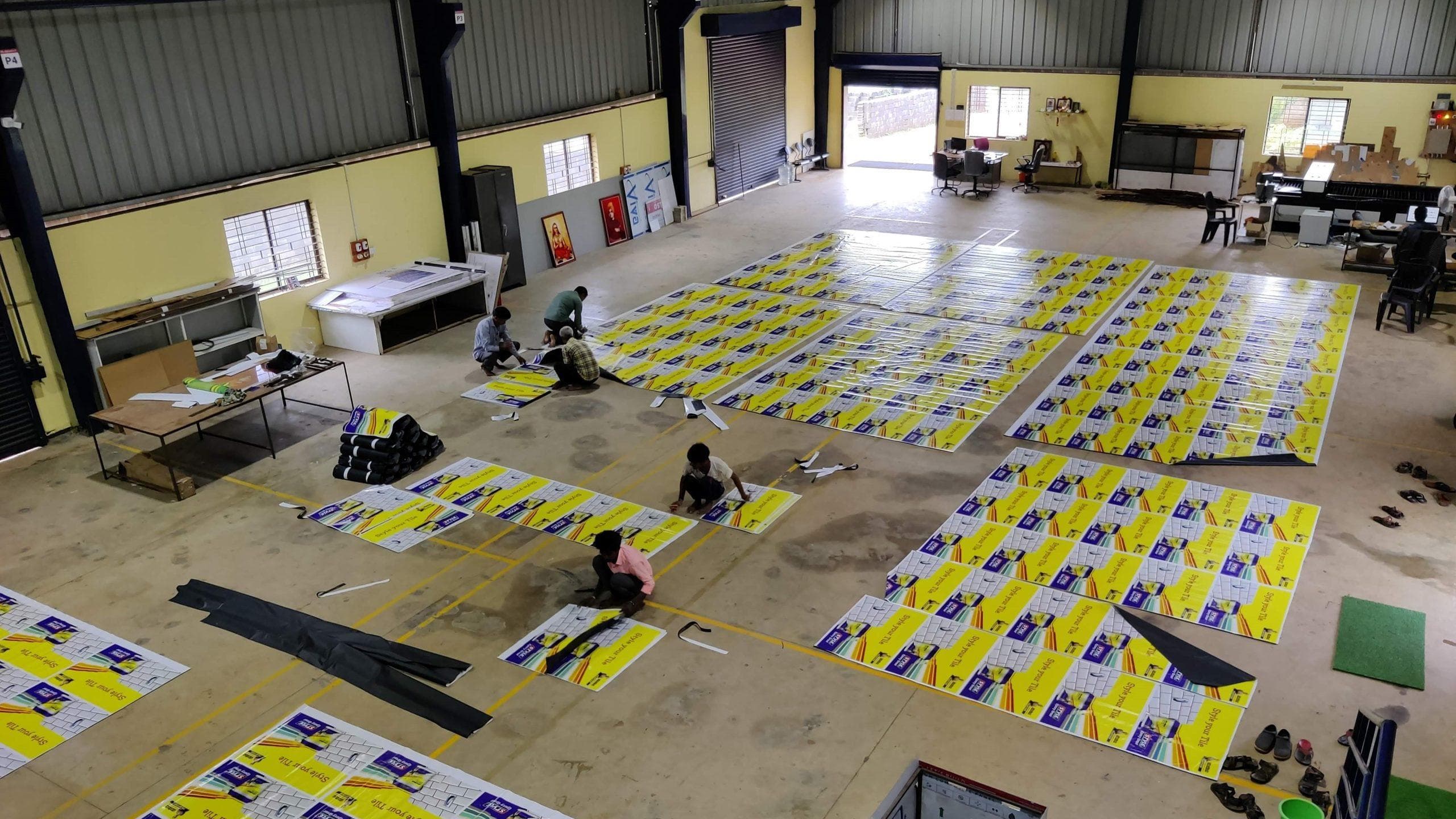
Three ink chemistries dominate Indian large-format printing in 2026: UV-curable, conventional solvent, and eco-solvent. The marketing language around them is sloppy. Vendors claim eco-solvent is solvent-free. It is not. Solvent printers get sold on speed at the cost of fade life. UV gets sold as universal at the cost of media compatibility. The honest engineering picture is that each chemistry has a job it is best at, and a job where it is the wrong tool.
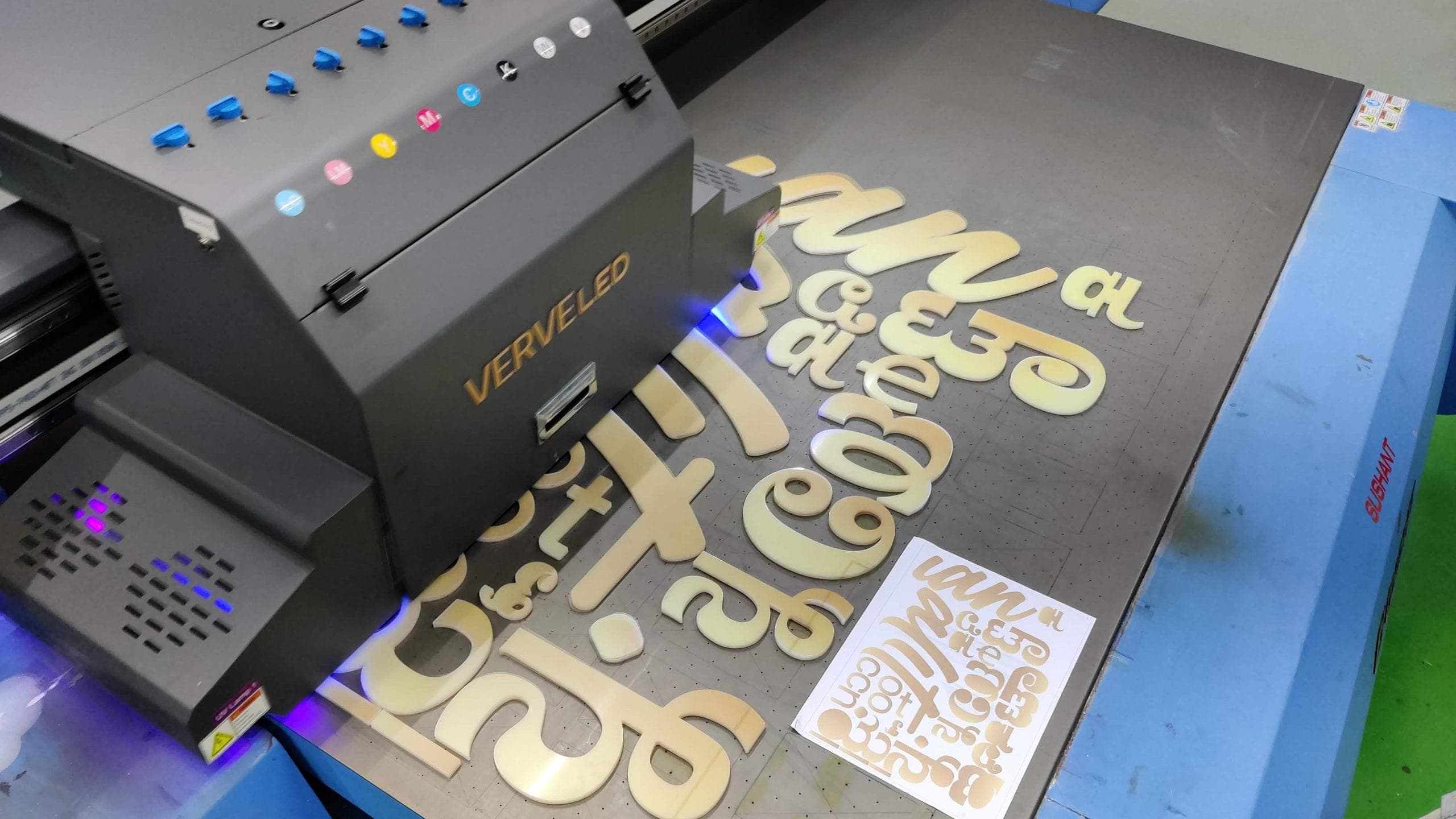
UV-curable printing uses inks that are liquid until they pass under UV-LED or UV-mercury lamps that polymerise the ink instantly into a solid film. The result is a print that is dry as soon as it leaves the machine, can be printed on virtually any rigid or flexible substrate including non-absorbent materials like glass, acrylic, ACP, foam board, wood, metal, and ceramic, and that has a hard cured surface resistant to scratching and chemicals. UV inks contain photo-initiators and acrylate monomers — they are not solvent-free in the formulation sense, but they emit zero VOCs in the print process. White ink and varnish layers are standard, which opens up backlit applications, multi-layer effects, and printing on coloured or transparent substrates. The production speed is excellent for short and medium runs.
Where UV is the right answer. Rigid signage. ACP fascia panels. Direct-to-board on foam, MDF, acrylic. Backlit lightbox faces with white-ink layered prints. Industrial labelling, control panel overlays, instrument scales. Premium photo prints behind glass. Anything that needs durability, a hard surface, and immediate finishing. Outdoor unlaminated UV print durability is realistic at three to five years before noticeable fade, and laminated runs seven plus.
Where UV is the wrong answer. Stretchable vinyl wrap film. The cured ink is too rigid for vehicle wrap conformability — it will crack on compound curves. Heavy heat-bend operations. Some flex banner constructions where the PVC will absorb and flex more than the ink layer can tolerate.
Conventional solvent printing — true solvent — uses aggressive solvents like cyclohexanone to chemically bite into the receiving substrate, depositing pigment directly into the surface layer of the vinyl or banner film. The resulting print is extremely durable outdoor — five to seven years unlaminated, eight plus laminated — and the ink becomes physically part of the substrate, which is why solvent prints are still the standard for billboard hoardings, large outdoor flex banners, and high-volume vehicle graphics. The downside is the obvious one: aggressive solvents mean significant VOC emissions, mandatory exhaust ventilation, longer outgassing time before lamination (24 to 48 hours), and operator health considerations. Most modern installations have moved on from true solvent because of the working environment, although the print durability remains the gold standard for very long-life outdoor work.
Eco-solvent uses milder glycol ether solvents — still solvents, just less aggressive and lower in VOC. The trade-offs are real: marginally lower durability than true solvent (three to five years unlaminated outdoor), better operator environment, faster outgassing (typically 12 to 24 hours before lamination), and very wide media compatibility. Eco-solvent is the standard workhorse for vehicle wrap, indoor and outdoor banners, retail point-of-sale graphics, vinyl decals, wall murals, and most jobs where you need the conformability of a flexible film with reasonable outdoor life. Roland, Mimaki, and Mutoh dominate the machinery side.
The spec questions to ask your printer. One: what is the ink chemistry? Demand the answer in writing — UV, true solvent, eco-solvent, or latex (a fourth chemistry, water-based with heat curing, growing in retail and indoor work). Two: what is the warranted outdoor life unlaminated, with lamination, and with overlamination film? These three numbers should be different. Three: what is the recommended outgassing time before lamination? Four: what is the maximum print width and the typical droplet size? 4 picolitre droplets and below give photo-quality output, 6 to 8 picolitre is standard for sign work, 12 picolitre and above are large-format banner heads only.
Which machine for which job. Vehicle wrap on cast vinyl: eco-solvent or latex. Hoarding and large outdoor flex banner: solvent or eco-solvent. Direct print to ACP, foam board, or rigid signage face: UV-curable flatbed or hybrid. Backlit lightbox face with white ink layer for opacity control: UV-curable. Indoor wall mural on PVC-free fabric or paper: latex. Retail POS and shelf strips, indoor graphics: latex or eco-solvent.
Cost benchmarks May 2026, per square foot, single-side print without lamination, mid-volume run. UV direct to ACP: rupees 65 to 95. Eco-solvent on cast vinyl: rupees 45 to 70. Solvent on flex banner: rupees 28 to 45. Latex on PVC-free wallcovering: rupees 95 to 140. Lamination adds 15 to 30 per square foot depending on film grade.
The procurement reality is that no single ink chemistry covers every job. A serious vendor runs at least two, usually three. We run UV (Kyocera-head flatbed), eco-solvent, and latex on the production floor — see the equipment list on /services under wholesale printing.
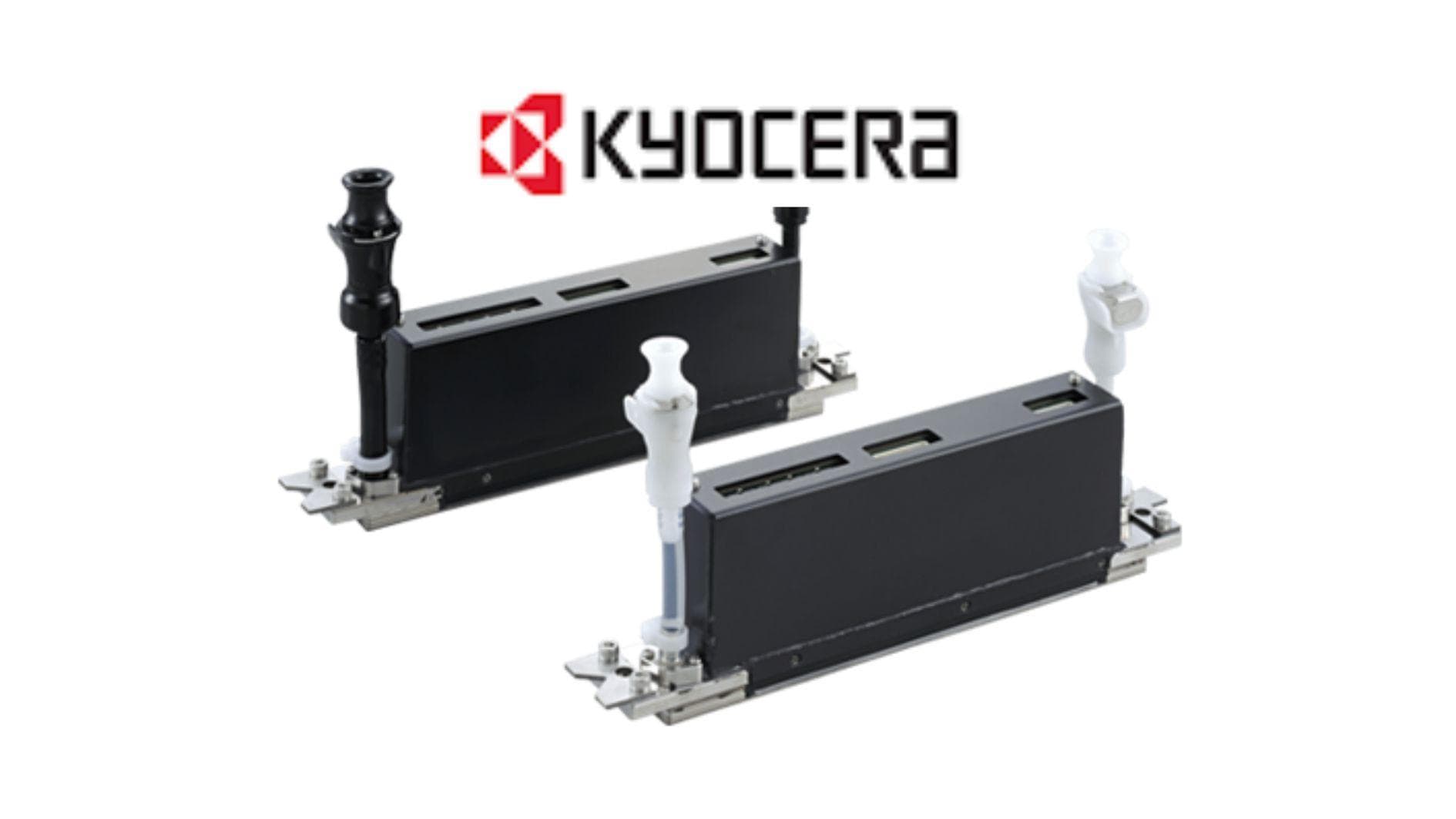
A word on print head technology because procurement teams sometimes ask about it during technical evaluation. Kyocera heads (KJ4B and similar) are the workhorse industrial print head used in serious flatbed UV machines — high droplet ejection frequency, long head life, replaceable nozzle plates. Ricoh Gen5 and Gen6 heads are the alternative premium head, slightly different droplet behaviour, used in many UV and some eco-solvent machines. Konica Minolta heads (KM1024 series) are the third premium option, used in some hybrid and high-resolution machines. Epson DX5, DX6, and DX7 heads are the budget standard found in most entry-level eco-solvent printers — acceptable for retail point-of-sale work but not for premium hospitality or backlit work where droplet consistency matters. Ask the vendor what print head their machine uses; it tells you more about the output quality than the brand name on the chassis.
Colour management and ICC profiles are the other quality lever inside a print job. A serious printing vendor maintains custom ICC profiles for each ink-substrate combination they run, and operates a calibrated colour workflow with a spectrophotometer for periodic verification. The result is print-to-print colour consistency across runs and across vendors. If your brand identity has a defined Pantone palette, ask the vendor to demonstrate Pantone matching capability with a printed colour proof against the Pantone bridge guide. The closer the match, the better the colour management workflow.
Lamination and finishing add their own variables. Cold lamination (pressure sensitive adhesive laminate applied at room temperature) is the standard for most large-format printed graphics — easy to apply, no heat damage to the print, wide laminate options. Hot lamination is used for some specialty applications. Liquid lamination (UV-cured liquid coating applied across the full sheet) is a niche premium finish for high-end work. Specify cold lamination with matched film and laminate from the same brand family wherever possible.
Laminate gloss level is a brand-relevant choice often overlooked. Gloss laminate gives a high-shine finish that intensifies colour saturation but reflects ambient light during the day, which can wash out the graphic in direct sun. Satin laminate (semi-gloss) is the workhorse middle ground — colour stays saturated, reflection is controlled. Matt laminate gives a flat finish suitable for premium retail and corporate work where the muted appearance is the design intent. The laminate gloss level should be specified per project; defaulting to gloss on every job produces inappropriate finishes for half the work.
Outgassing time before lamination is the production discipline that separates serious vendors from sloppy ones. Solvent and eco-solvent prints must outgas the residual solvent before the laminate is applied, otherwise the trapped solvent forms bubbles between the print and the laminate weeks or months later. Manufacturer recommended outgassing time is 24 hours minimum for eco-solvent, 48 hours for true solvent. Vendors who skip outgassing produce prints that look fine on the day of delivery and fail on the wall four months later. Ask the vendor what their outgassing protocol is and where the outgassing happens (separate ventilated room, not the print floor). UV and latex prints do not require outgassing because the inks cure or dry immediately after print, which is one operational advantage of those chemistries.
The right ink chemistry is the one that matches the substrate and the install location, and the wrong one will fail on either the day of install (poor adhesion) or 18 months later (fade or peel). Send the substrate spec, install location, and required life to /contact and we will quote with the correct chemistry and the warranty terms — including print head model, ICC profile, lamination gloss level, and outgassing protocol on the technical data sheet.