Real estate hoardings are the most over-promised and under-managed signage category in the market. A developer launches a project, the marketing team books fifteen hoarding sites across the city, and the brief that goes to the printer is roughly: 'Here's the artwork, give us a quote, we need it up by Saturday.' Saturday becomes Tuesday, Tuesday becomes the following Sunday, half the sites have the wrong dimensions, two have wind damage by month-end, and the launch campaign is salvaged by social media spend that the marketing director was hoping to keep for phase two.
This is preventable. The brief that saves six weeks on a real estate hoarding campaign is not complicated, but it has to exist before the artwork does, not after.
Start with the site survey. Most developers skip this and rely on the outdoor agency's site list. The outdoor agency is being paid to sell inventory; they are not being paid to give you a fabricator's eye on the site. A real site survey, done by the print and fabrication vendor, captures for each location the actual mounting structure (existing hoarding frame, pole-mounted, building-side bracket, ground-level structure), the surface condition, the wind exposure, the ambient lighting at night, the accessibility for installation crew, the power availability if illuminated, and the surrounding visual clutter. Three hours per site, ideally during both day and night, gives you a brief that a fabricator can price properly.
Dimensions matter more than developers think. A 40-by-20-foot hoarding is not the same job as a 20-by-40-foot one even though the area is identical. The structural load profile is different, the seam pattern is different, the printing sheet count is different, and the installation rigging is different. Specify width and height as separate numbers in millimetres, and if there is any tolerance — say plus or minus one panel for fitting — write it in. Don't assume the fabricator will figure it out, because they will figure it out by guessing and you will not like the guess.
Material choice is where six weeks gets saved or lost. The dominant material for outdoor real estate hoardings is flex — frontlit flex for non-illuminated, backlit flex for illuminated. Within flex, there are grades. The cheap stuff is 280 GSM with a basic mesh weave; it tears in the first strong wind, fades in eight weeks of summer sun, and visibly bows in two weeks. The honest minimum for a six-month campaign is 440 GSM with anti-fungal coating, UV-stabilised inks, and a tested wind-load rating. The premium grade for a year-plus campaign is 510 GSM with edge reinforcement and corner eyelets at every meter. The price difference between cheap and honest is roughly thirty percent. The cost of replacing a torn hoarding mid-campaign is two hundred percent and your project's name attached to a flapping rag for the week before replacement.
For longer campaigns or premium developments, increasingly the choice is moving to ACP-and-vinyl rather than flex. ACP holds dimension perfectly, doesn't bow, doesn't fade as fast, and looks sharp even at night without illumination because the surface doesn't ripple. The cost is roughly two-and-a-half times flex but the lifespan is roughly four times. For your launch hoardings on the four key arterial sites, ACP earns its keep. For the volume sites in the support belt, flex is correct.
Illumination is the lever most developers underuse. A backlit hoarding at night, on a busy intersection, generates roughly three to five times the impressions of a non-illuminated one. The cost premium is the lighting rig — typically high-output LED bars with photo-cell auto on/off — and the ongoing electricity. For a six-month campaign on a flagship project, this is almost always justifiable. The brief should specify whether each site is to be illuminated, what the lighting hours are, and who pays for the electricity (usually the developer, billed against the site permission).
Artwork preparation is the silent killer. A hoarding artwork that looks beautiful on a designer's monitor at 100 percent zoom looks terrible on a forty-foot hoarding because the resolution wasn't built for the size. The fabricator needs the artwork at the correct resolution for the print width — typically 100 dpi at full size for flex, 150 dpi for ACP — with bleed, with crop marks, with the colour profile tagged, and as a flattened file with all fonts converted to outlines. Sending a layered Photoshop file three days before installation is asking for a print that doesn't match what was approved on screen. The brief should include an artwork preparation checklist, and the fabricator should have a single named person who reviews artwork against the checklist within twenty-four hours of receipt.
Permissions for real estate hoardings are tighter than developers think. Municipal permission for outdoor advertising is mandatory in every major city. The permission is site-specific, time-bound, and increasingly subject to standardised hoarding norms — frame design, mounting depth, illumination wattage, and visibility from priority road categories. The outdoor agency typically holds the permission for the inventory they sell, but the developer is responsible for content compliance — meaning the artwork must not violate the city's content rules (no specific projects to call out here, but the rules around RERA disclosure, project approval status, and pricing claims are strict and increasingly enforced). The brief should include a content compliance review step before printing, with a named legal or compliance reviewer signing off.
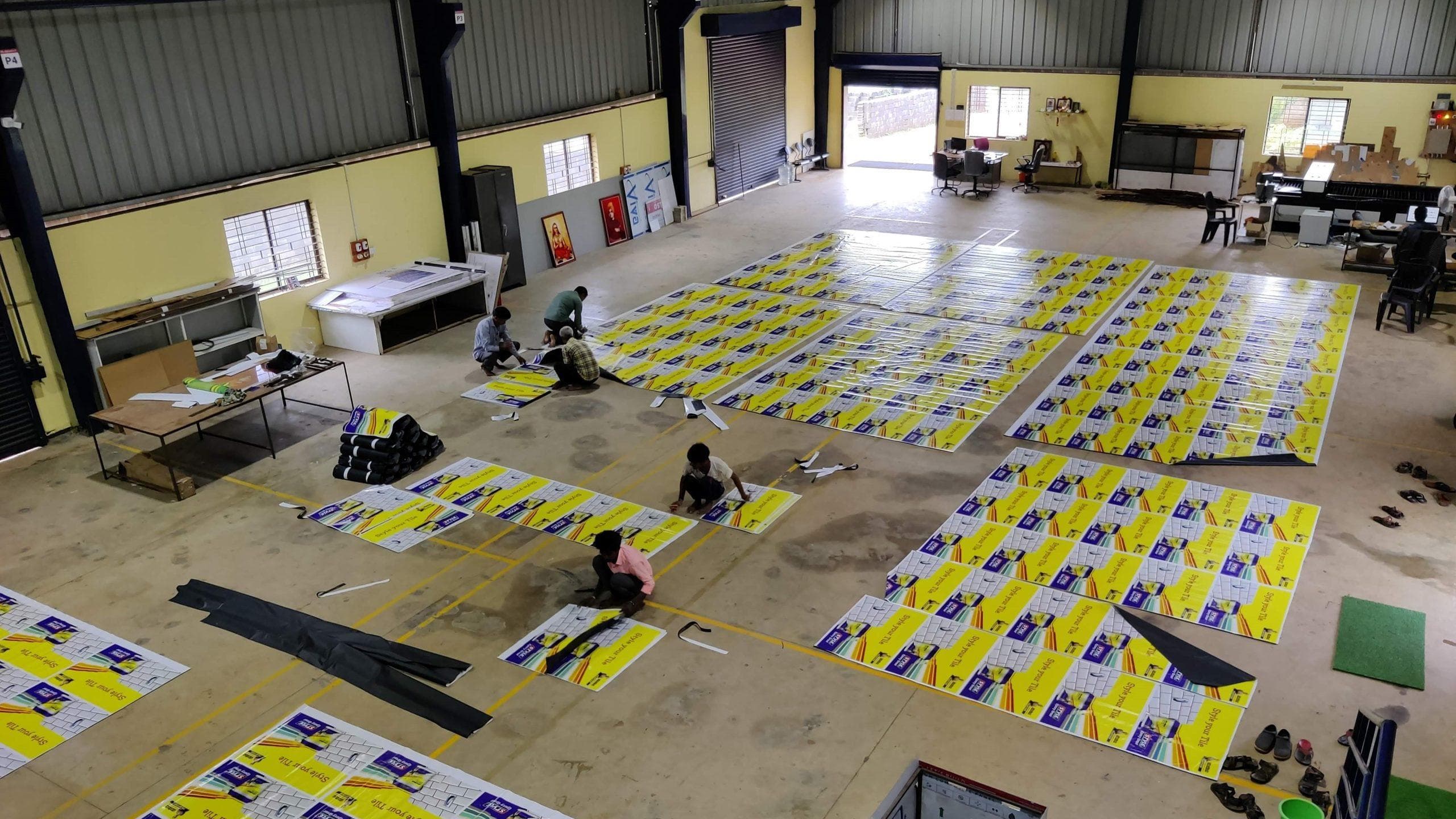
The rollout schedule is the part that always slips. A fifteen-site outdoor campaign cannot be installed in three days. The realistic timeline from approved artwork to all sites live is seven to ten working days, assuming permissions are in hand and crew is mobilised correctly. The fabricator's printing capacity is the constraint — even a large-format shop can typically print four to six full-size hoardings per day on a single machine, and the installation crews can handle three to four sites per day per crew. Build the schedule with these constraints visible and you will hit the launch date. Hide the constraints and you will not.
The wind question is the underrated risk. A single major wind event can take down half a campaign. The brief should specify wind-rated mounting hardware, edge reinforcement on the flex, and a service response SLA for storm damage — typically forty-eight hours for replacement of damaged hoardings. The fabricator with an /amc style ongoing service relationship is the one who answers the call on Sunday morning. The fabricator who quoted lowest is the one who is unreachable.
A real estate hoarding brief that saves six weeks has, at minimum: a per-site survey document, dimensions in millimetres, materials specification with grade, illumination plan with electricity ownership, artwork checklist, permission status, content compliance sign-off, rollout schedule with crew and printing capacity, and storm response SLA. It is six to ten pages of actual content, not a one-paragraph email and an attachment. The developers who write this brief well are the ones whose launches feel calm. The ones who don't are the ones whose marketing directors are answering 'why is the hoarding still down' calls on a Wednesday afternoon.